
اردو میں پڑھیں: ANGPTL3 کی In Vivo Base Editing: ایک خوراک میں DNA کی مستقل تبدیلی کیا ثابت کرتی ہے؟
Scope: Research and education. This article explains a newly published laboratory and animal study. It is not medical advice, and nothing here describes an available treatment.
Last reviewed: 9 November 2026
On 6 November 2026, Nature published a peer-reviewed study describing a single-infusion gene-editing approach that permanently switches off one gene in liver cells. The target is ANGPTL3, a gene whose protein product keeps blood lipid levels higher than they would otherwise be. The reported reduction in nonhuman primates was still present three years after one dose.
For readers following genome editing, this paper is useful for two reasons. It is a clear worked example of base editing rather than gene cutting, and it shows what a serious preclinical package for a somatic editing therapy looks like. It is equally useful as a lesson in reading such results carefully: almost all of the efficacy data come from animals, and the human part of the story has only just begun.
On this page
The gene at the centre: ANGPTL3
ANGPTL3 encodes angiopoietin-like 3, a protein made mainly in the liver and released into the blood. It restrains enzymes that clear fats from the circulation, so more ANGPTL3 activity means higher circulating lipids, including LDL cholesterol and triglyceride-rich particles.
What makes the gene attractive as a target is human genetics rather than a laboratory hunch. People who naturally carry loss-of-function variants in ANGPTL3 tend to have low lipid levels, and population studies have associated that state with lower cardiovascular risk without an obvious cost to health. In other words, nature has already run a partial experiment on what happens when this gene works less well. That kind of human sequence evidence is one of the strongest arguments a drug target can have, although it is suggestive rather than conclusive.
Base editing is not the same as cutting DNA
Classic CRISPR-Cas9 makes a double-strand break and lets the cell repair it, which produces a mixture of insertions and deletions and carries a risk of larger rearrangements. A base editor works differently. It pairs a Cas protein that has lost its cutting activity with an enzyme that chemically converts one DNA base into another. An adenine base editor, as used here, changes an A·T base pair into a G·C base pair at a precisely targeted position, without severing the backbone of the DNA.
The practical consequence is that a single intended letter change can disable a gene — for example by destroying a signal the cell needs to assemble a working transcript — while avoiding the messier outcomes of a break-and-repair event. The edit is made in the body’s own liver cells, not in eggs, sperm or embryos, so it is a somatic change that is not passed to children. It is, however, permanent in the cells that receive it.
What the study actually did
The editing machinery was delivered as instructions rather than as protein: a guide RNA plus messenger RNA encoding the base editor, packaged inside a lipid nanoparticle. The particle carried a GalNAc sugar tag, which is recognised by a receptor found in large numbers on liver cells, biasing uptake towards the intended tissue. Because mRNA is short-lived, the editor is made briefly, does its work, and disappears — while the DNA change it leaves behind does not.
The work ran across three layers of evidence:
- Human liver cells in culture, to confirm that the intended base-pair change was installed at the ANGPTL3 locus and to search for edits elsewhere in the genome.
- Mouse models of high blood lipids, to measure what inactivating the gene does to lipid levels.
- Nonhuman primates, to assess tolerability, the size of the effect on the circulating protein, and how long a single dose lasts.
What they found
In the cultured human liver cells, the authors report no detectable off-target editing at roughly 3,000 candidate sites that they screened, and no treatment-related structural changes to the genome.
In nonhuman primates, one dose reduced circulating ANGPTL3 protein by more than 90 per cent on average, and that reduction was still present when the animals were followed out to three years. The authors describe the treatment as well tolerated in these studies.
In the mouse and primate models of high blood lipids, switching off the gene was accompanied by reductions of roughly 40 to 50 per cent in LDL cholesterol and roughly 50 to 70 per cent in triglycerides. The paper presents this package as the scientific basis for a first-in-human clinical trial that is now under way in people with lipid disorders that do not respond adequately to existing options.
Why it matters beyond lipids
Three general points are worth drawing out, whatever happens to this particular programme.
First, the durability data are the headline for the field, not the percentages. A three-year effect from one infusion is the kind of result that distinguishes a DNA edit from a drug that must be taken repeatedly. It also raises the stakes, because an edit cannot be stopped if a problem appears later.
Second, delivery is doing as much work as the editor. Targeting a specific tissue with a nanoparticle, and using transient mRNA so that the editing protein is not around permanently, are the engineering decisions that make a somatic edit tractable. Much of the current progress in the field is delivery progress.
Third, this is human genetics feeding back into the laboratory. The target was chosen because sequencing in populations revealed people who already live with less of this protein. Variant interpretation work — including the kind of annotation and prioritisation discussed in our notes on AlphaGenome Atlas and on reading a VCF file — is upstream of experiments like this one.
Limitations worth keeping in view
- The efficacy evidence is preclinical. Mice and monkeys are not people, and lipid biology differs between species.
- The endpoints are biomarkers. Lowering LDL cholesterol and triglycerides is not the same as showing fewer heart attacks or strokes. Only long clinical trials can test that.
- Off-target screening has limits. Finding nothing at about 3,000 candidate sites is reassuring, but it is bounded by which sites were nominated and how sensitive the assay was. It is not a guarantee that the rest of the genome is untouched.
- Three years is long, not lifelong. Durability beyond the follow-up period, and rare late effects, remain open questions.
- Irreversibility cuts both ways. A permanent edit removes the problem of missed doses and also removes the option of stopping.
- The work is industry-sponsored. The authors are affiliated with the company developing the approach. That is normal for therapeutic development and is a reason to weight independent replication, not a reason to dismiss the data.
- A trial being under way says nothing about its outcome. Most candidate therapies that reach first-in-human testing do not reach approval.
How to read a paper like this
A useful habit with gene-editing announcements is to separate four questions that often get merged in coverage:
- What was edited, and where? Which gene, which position, which tissue, and somatic or germline.
- What was measured? A molecular readout, a biomarker, or a clinical outcome — these are very different levels of claim.
- In what system? Cultured cells, mice, nonhuman primates, or humans.
- For how long, and in how many? Duration of follow-up and number of animals or participants set the limits of what can be concluded.
Applied here, the honest summary is narrow and still notable: in animals, one dose of a liver-targeted base editor produced a deep and lasting reduction in a lipid-raising protein, with no off-target editing detected in the screens performed, and human testing has started.
Research and education notice: This article summarises published research for learning purposes. It is not medical advice and does not describe an approved therapy. Decisions about cholesterol, cardiovascular risk or any treatment belong with a qualified clinician.
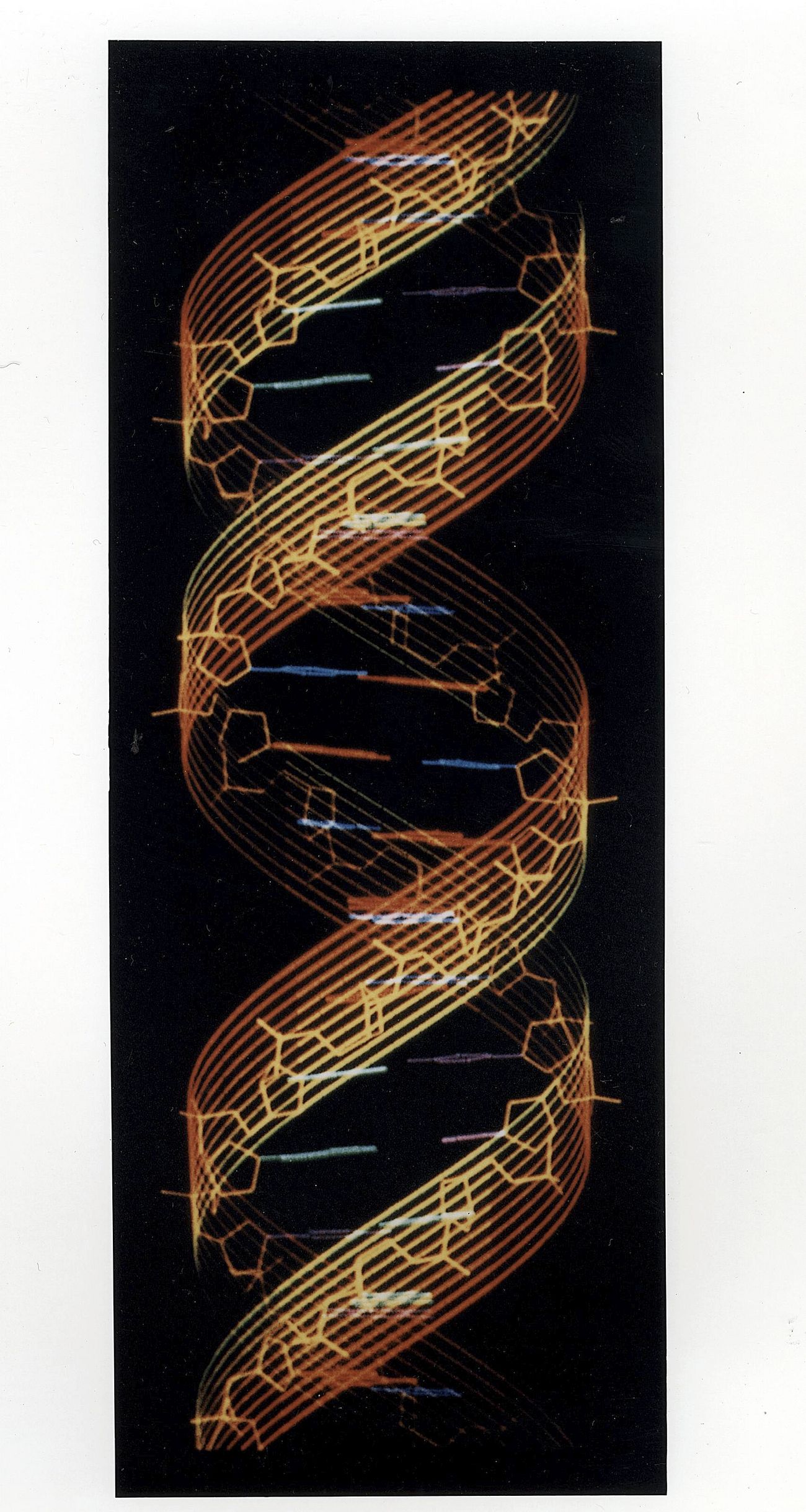
Featured image: the structure of DNA. Image by the U.S. Department of Energy, dedicated to the public domain under CC0 1.0.
Sources
- Mizoguchi T, et al. In vivo CRISPR base editing of ANGPTL3 for durable lipid lowering. Nature. Published 6 November 2026. doi:10.1038/s41586-026-11233-9 (record retrieved from PubMed, PMID 42994815)
- Gaudelli NM, et al. Programmable base editing of A·T to G·C in genomic DNA without DNA cleavage. Nature. 2017;551:464–471. doi:10.1038/nature24644
- Musunuru K, Kathiresan S. Genetics of common, complex coronary artery disease. Cell. 2019;177(1):132–145. doi:10.1016/j.cell.2019.02.015
Bibliographic details for the primary study were retrieved from PubMed.

A molecular biologist and aspiring bioinformatician with a passion for genomics, rare diseases, and precision medicine. With an MPhil in Molecular Biology and experience in genetics and genomics, he has contributed to clinical research projects on rare genetic disorders. He’s passionate about making genomic data meaningful — and ultimately helpful — for patients and clinicians alike.


Leave a Reply